
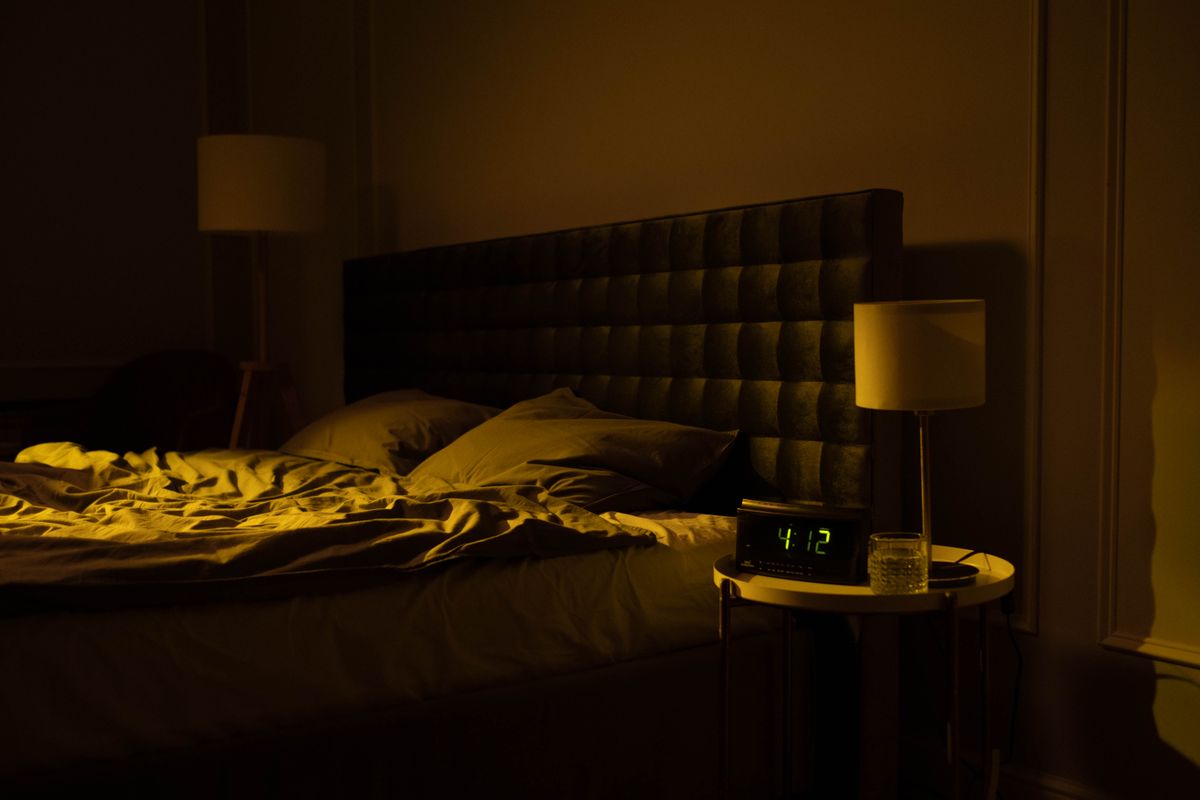
At 2am the content of the line is almost irrelevant. What matters is that it's short enough to say without thinking, and that it gives your attention something to hold that isn't tomorrow. Pick one line before you get into bed. Say it on a slow out-breath. Don't reach for the phone to find a better one.
That last instruction costs this article a page view and it's the one worth keeping.
Why a short line works at all
Not because of what it says. Because of what it occupies.
Forty-one people with insomnia were given one of three sets of instructions for a single night: distract yourself with imagery, distract yourself generally, or nothing. The imagery group fell asleep sooner than the no-instruction group and rated their pre-sleep thoughts as less uncomfortable than either other group. They'd been asked to imagine something interesting and engaging, but also pleasant and relaxing.
A repeated line is a low-effort version of the same move. It gives the part of your mind that wants to rehearse tomorrow's conversation something else to rehearse. This is also why complicated affirmations fail here: anything you have to parse is a task, and a task wakes you up.
The breathing half is separate and better established. Slow breathing means fewer than ten breaths a minute, and below that rate the balance shifts toward the parasympathetic side. Four in, seven holding, eight out lands you well inside that range without needing to count minutes.
One honest caveat about the pattern. You'll read everywhere that a longer exhale is the active ingredient. That claim is contested: an experiment and its replication found no difference in heart rate variability between an even ratio and a doubled one, and nine earlier studies reached four different conclusions. Slow is what's supported. The shape is folklore that may turn out to be true.
Twenty-two lines, by what's keeping you up
Read the group that matches tonight. Pick one. Say it on the out-breath, in a whisper if there's someone next to you.
When you can't switch off
- Nothing gets decided at this hour.
- The list will still be there. It doesn't need me now.
- I'm allowed to stop thinking about this until morning.
- This is my body resting even if my mind hasn't caught up.
- Out-breath. Then the next one.
- I've solved harder things after sleeping.
- Not tonight's problem.
When you've woken at 3am
- It's the middle of the night. Nothing is as bad as it looks now.
- I don't have to fall asleep. I just have to lie here.
- My eyes are closed and that counts for something.
- This has happened before and the morning came anyway.
- Slow out. Slower than feels necessary.
When you're dreading tomorrow
- Tomorrow gets tomorrow's version of me.
- I can be nervous and still sleep.
- Whatever happens, I'll be there for it.
- I've done frightening days on bad sleep before.
- Lying still is preparation too.
- It's out of my hands until 9am.
When the body is still wired
- Jaw. Shoulders. Let them go.
- My chest is tight and it's easing on the out-breath.
- Heavy hands, heavy legs.
- I'm not fighting this, I'm just breathing slower than it.
Most of those are variations on two ideas: nothing gets decided now, and lying here is enough. That repetition is the point rather than a shortage of imagination. You don't need range at 2am, you need a sentence familiar enough that saying it costs nothing.
How to actually use one
Say it on the out-breath, not the in-breath. The exhale is longer and slower, so the words come out at the pace you want the rest of you to move at.
Then say it again on the next one. And again. You're not aiming for a number of repetitions and there's no point at which it's done: you're giving your attention a low-effort place to be, and you'll know it's working because at some stage you'll lose track of whether you're still saying it.
Your mind will go back to the thing. That's not failure, it's the normal shape of this. When you notice, go back to the line without commentary. The commentary is what wakes people up: the I'm doing this wrong, I'll be exhausted tomorrow, it's already 2.40 spiral does more damage than the original worry did.
If the line stops meaning anything after a while, that's fine too. Meaninglessness is close to what you're after. A phrase that has worn smooth is easier to repeat than a fresh one, which is another reason not to go looking for a better sentence at three in the morning.
The phone problem
Here's where most sleep affirmation content quietly works against you.
A list of fifty lines on a screen requires scrolling, comparing, and deciding which one fits. Those are the three activities you're trying to stop. Add the light and the fact that the same device holds your email, and the tool becomes the obstacle.
So: choose the line before you get into bed, or let it be read to you. Hearing a line asks nothing of you. Reading one asks you to keep looking at a screen, and screens are the one variable in this whole area that nearly everyone agrees about.
There's a version of this that's worth naming because people arrive at it on their own: counting backwards from three hundred, naming countries in alphabetical order, walking through the layout of a house you used to live in. Those work on exactly the same principle as a repeated line. Anything mildly engaging, pleasant and not about tomorrow will do. If a sentence feels too earnest for you at 3am, use the house.
Face-down, and read aloud
The relaxing technique in AffirmateMe is 4·7·8, ending on the exhale, in sessions of three, four or five affirmations. Affirmations can carry narrated audio and the breathing session has optional spoken cues, so the phone can stay face-down on the mattress while it runs.

When this doesn't work
If you've been sleeping badly for weeks, none of this is the right tool and continuing to look for a better script is a way of avoiding the useful step. Persistent insomnia is a medical matter with treatments that have far stronger evidence than anything on this page. Go and get one of those.
Be careful with the breathing claim too. The month-long trial that tested structured breathing patterns against meditation found no change in sleep measures in any group, including the one that improved most on mood. Slow breathing is a reasonable way to stop speeding up. It is not a demonstrated sleep intervention, and an article promising otherwise is selling you something.
And if the line itself makes you feel worse rather than steadier, drop it. That happens to some people with positive self-statements and it's worth knowing rather than pushing through.
The version of this done before bed rather than in it is the evening wind-down, which is a better place to start if you're still up and moving. For the daytime pattern and why its breath hold is wrong for tonight, see box breathing.